 Ugh, I knew I forgot something this week! Fortunately there are still a few days left and as of this moment, no bids!
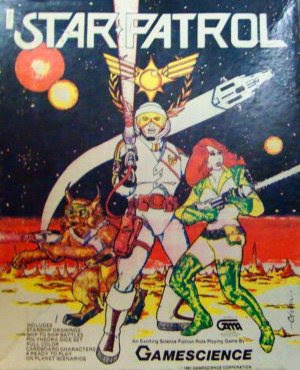
Here's an auction for the 1981 Gamescience box set of Star Patrol, another iteration of Michael Scott Kurtick's Space Patrol system and very similar to Star Trek Adventure Gaming in the Final Frontier, and the predecessor to Terra Games' 1982 Starfleet Voyages.
The listing says "1977", but the game wasn't released until 1981. The box looks to be in very good condition (better than mine!), and it says it's complete. That should mean a bag of Gamescience precision dice, 67 page rulebook with tables and maps, a big foldout deckplan of a Pioneer-class starship, a hexmap, color standup cardboard characters and vehicle counters.
From the auction listing:
Star Patrol is an early D&D-like science fiction role playing game. Character traits are generated with 3D6. Traits are Strength, Dexterity, Constitution, Charisma, Luck and Mentality. The game had other standard D&D features like psionics and savings throws. Instead of fighter, magic user, cleric character classes, Star Patrol has character professions like soldier, engineer, scientist, astronaut, trader, rogue, and spy/diplomat. Characters can be one of 32 alien races. You can also generate your own weird alien race by rolling against random tables, generating a "general type" (mammal, avian, or even a plant or crystalline derivative), a "general shape" (2, 4, 8, or more legs), size, and even your race's home planet's gravity (low, earth-like, or heavy).
Saturday, June 6, 2009
Trek RPG Auction of the Week - 6/2/09


Saturday, March 21, 2009
Heritage's Star Trek RPG In-Depth (Part 2)
 Today I'm going to wrap up my in-depth review of the rulebook for Heritage's 1978 Star Trek Adventure Gaming in the Final Frontier (STAGFF), then move on to fan written works that added to the original game. In Part 1, I covered the Basic Game rules and scenario. To sum up my findings so far:
- STAGFF is better organized and presented and more playable than its predecessor, Space Patrol.
- The Basic Game is based upon using the classic Trek characters (Kirk, Spock, Koloth, etc.) and provides stats for them.
- For the most part, the Abilities -- Strength (ST), Dexterity (DX), Luck (LK), Mentality (MN), Charisma (CH), and Constitution (CN) -- are each applied to only one or two specific tasks with modifiers. No Skill system is given.
- The game suffers from unnecessary complexity.
- The Basic Game provides a brief Scenario called "The Shuttlecraft Crash" and includes a map.
- Even in comparison to the few other RPGs of the time, STAGFF feels more like a wargame, and feels nothing like Star Trek itself.
Over 1,000,000,000 years ago the Slavers ruled the Galaxy. They died off when one of their subject races rebelled with sufficient ferocity. The only known remains of the last Slaver Empire are Stasis boxes. These are special force field boxes in which time stands still. These boxes can be opened using a magnetic probe and they often contain artifacts, devices and other remains of the lost Empire. Just such a box gave the Federation its anti-gravity technology used on starships. Another stasis box contained a super-weapon that was lost due to Kzinti intervention. The slaver stasis boxes are the most sought after archaelogical treasures in the known universe.
The scenario opens with the ENTERPRISE shadowing an alien vessel traveling in unknown territory. The alien vessel, possibly a Kzin or Klingon ship (this is at the discretion of the Mission Master. Any aliens can be used. When aliens are mentioned in this scenario they will be called aliens, but the Mission Master can fill in whatever aliens he thinks would be appropriate) makes a landing on a small Class M world near a partially ruined building. The alien crew, numbering 8 individuals, are seen getting out and entering the building. The ENTERPRISE sends down a party of 6 crewmen to investigate.
 The planet has been seeded by the ancient race known as the Providers and has animals from many parts of the Galaxy. The building in the ruins is an ancient Slaver outpost and contains 4 stasis boxes hidden within its walls along with various creatures and the searching alien landing party. The Star Fleet crew must prevent the stasis boxes from falling into the hands of the aliens. The walls of the building are made of a Slaver alloy which prevents the operation of the communicator (and thus the Transporter) and tricorder readings are only partially effective through its walls. Doors in the building are sliding doors requiring a strength of at least 13 to open or can be burned down by a phaser set on Dematerialize. The aliens are hostile and will attack the Federation crewmembers on sight.
So that's kind of cool. A sequel of sorts to the 1973 Star Trek animated series episode "The Slaver Weapon" by Larry Niven, and author Michael Scott even got Kzin/Kzinti correct! And an adventure on a planet seeded with the remnants of both Slavers and Providers? All it needs are the Ringers from the Enterprise RPG scenario "The Drifting Ring", and we'll have all the Ancients covered.
In all seriousness, a few things worth noting. First, the "dungeon crawl" nature of the mission is pretty obvious: kill the Kzinti, find and take the treasure. It feels more like a D&D adventure than anything actually inspired by a Star Trek episode. Second, here is evidence that as early as 1978, the question of how do deal with the Transporter in a Star Trek RPG is identified as problematic (and still discussed today, as shown in one of this week's more popular threads on RPGnet). Prospective GMs take note: "Slaver Alloy" as an alternative to "Ion Storm". Third, I do find it interesting that there are some similarities between this Scenario and the one included with the Japanese RPG Enterprise (ancient race, stasis devices)... I wonder if Tama Yutaka had actually seen this game before he was inspired to write his own years later?
The Scenario is more interesting than the one in the Basic Game, and much more deadly. It makes use of the elements from the Advanced Game such as Psionics and some of the new creatures listed later on including the Capellan Power Cat, the Vulcan Sehlat and... the Mugato! Those whacky Providers.
The Scenario is followed by a brief section on custom Character Creation, which basically consists of rolling various dice for the six primary Attributes, the all-important Size attribute (right down to the centimeter) and Movement. The rule for awarding experience essentially amounts to two sentences, encouraging the Mission Master to award Attribute points and new equipment training for a successfully completed scenario.
The section on Psionics makes it clear that, with the exception of Vulcans and the Kziniti, characters will rarely have a Psionic power, determined by a roll (1% chance). If the roll succeeds, they roll to get Empathy (with a rule for Gem-like healing), Telepathy, Telekinesis, Clairvoyance, Precognition, Mind Control or Teleportation. Again, this section is very similar to the PSY Talents section in Enterprise. I suspect the list was influenced by Traveller Book 3 - Worlds and Adventures, but the random generation method looks to be Michael Scott's own, later borrowed and further polished by Yutaka. It's definitely not the Psionics of Eldritch Wizardry.
 The next section is on Familiar Star Trek Life Forms, a list of nearly 50 alien races and creatures from both TOS and TAS. Examples (note the use of the generic AR - Ability Rating - for creatures as opposed to alien races, as detailed in the Basic Game; note also, typos are not my own):
MUGATO - Great white horned ape of Neural with poison fangs. They mate for life and will avenge mate's death. Basic move: 12, Basic size: 250 cm, AR 18.
TELLARITE - Pig-like humanoids, they are members of the UFP and can be members of a Star Fleet crew. They are very argumentive and alcohol only makes them more so. Basic size: 175cm, Basic move: 10m, CH -2.
VULCANS - Pointed-eared humanoids of great emotional control and logic. Their blood is based on copper salts and they have protective nictating membrances to protect their eyes from dirt and glare. They have limited powers of telepathy and empathy in that they usually have to be in contact with a subject for the powers to operate. Once every seven years they must mate or die. Basic size 200cm, Basic move: 11m, ST +3, DX +2, MN +3, CT +4. They are members of the United Federation of Planets (in fact, one of the most highly regarded members) and are found throughout Star Fleet's crews. The Vulcan Spock is a successful hybrid of Vulcan and Human heritage.
Rules are also provided for Creating Alien Creatures, based on Space Patrol's random attribute generation method (3D6 for AR) and a series of tables: Type and Shape, Size, Special Capabilties, Size Modifier and Basic Movement.
The next sections are the Advanced Equipment Table and a 4-page List of Equipment and Weapons, many based on Star Trek items (ex: Lirpa, Phaser Bore, Phynburger (sic), Universal Translator, five types of Tricorders), and the rest corresponding roughly to that provided in Space Patrol. These are generally just descriptions with little or no detail as to their effects, provided later in the Advanced Game Weapons Tables that are part of Advanced Combat.
The Advanced Combat Rules don't add much to what was outlined for ranged and hand-to-hand combat in the Basic Rules. In fact, despite the four pages they occupy, the Advanced Rules really only add three things: a modifier for Initiative (or, as it's called throughout the book, "Initiation"), tables for the use of all the weapons previously introduced, and rules for the use of Armor and Shielding (in short, the value of the Armor Rating is subtracted from the damage when hit).
The book starts to wrap-up with simple instructions for creating custom Scenarios, re-uses Space Patrol's types of scenarios, and throws in a few Trek-ish bones into each such as this:
You may have realized that the players of a scenario do not have to be Star Fleet crewmembers. They could be Klingons, Romulans, or some other race. Think how nice it would be sometime to be able to solve a problem technologically and not be hampered by the Prime Directive restricting your every action. Admittedly the Star Fleet crew has the harder job, having to play by the United Federation of Planets' rules and still get the job done. But Kirk seemed to manage from week-to-week, and you can too.
It then gives some advice to the prospective Mission Master on how to keep players engaged by emphasizing the mystery to be solved in the story, and how to deal with players in general. This also leads to one of the stranger passages of the book:
(T)he Mission Master does not volunteer answers to questions that are not asked... Suppose that Spock was using the semi-sentient talking computer of the ship systems to scan an area . He asks for the computer to report any relevant dangers. It would be asking too much of the computer to understand Spock's unreasonable fear of the Groupies at a Star Trek convention. Thus, unless our favorite Vulcan asked, the computer would see no reason to mention his adoring fans waiting in the landing area.
 Both of these excerpts are examples of a few places in the game where you may sense a little disdain for Star Trek itself, but I think it's worth noting that STAGFF is really a product of its time.
First, it was 1978 and, in the wake of Star Wars, repeats of Star Trek were starting to feel a little dated. Yes, a big film was on its way in late 1979, but little was known about it. Star Trek and "Trekkies" were seen as cheesy and as objects of derision, even more so than today (for example, the 1976 SNL sketch with John Belushi as Kirk, and Mad magazine's Trek parody later that same year). The way I recall it (and I was only in my early teens in the late 70s), it really wasn't until the films and the Next Generation shows that Trek (even TOS) began to gain some wider respect in pop culture.
Second (and I've mentioned this before), 1978 was early for RPGs, which were still growing out of their wargame origins. The fact that STAGFF was created (probably on the cheap) only to help Heritage Models sell its Star Trek miniatures emphasizes that "role" was still being defined in gaming. At that time, it was probably inevitable that such a game would turn out to be "let's phaser things and take their alien treasure!" As a result, STAGFF is really just a great big list of things to kill, weapons to kill them with and the mechanics to do so.
I'd argue that things haven't improved much in this regard over the past 30+ years. Despite the noble efforts of FASA, LUG and Decipher to emphasize elements in their games such as diplomacy, the Prime Directive, character skills and "the needs of the many", the fact remains that the Trek games that have survived and done best over the years (tabletop or computer-based) are those that are focused on starship combat and "let's phaser things and take their alien treasure!" There have been a number of online discussions lately as to whether Trek is really suitable for roleplaying at all, especially when you have players (and GMs?) that focus on Trek-nology and do things like transport a photon torpedo over to the enemy's bridge (RPGnet thread).
I'm not trying to philosophize (not yet, that'll come later). I'm just pointing out that the easiest criticism to level at STAGFF -- that it's "not very Star Trek" -- is still true of Trek games today. In 1978, I'm not sure that mattered or offended all that much. And despite these strange passages in the rulebook, their are other places where you can tell that the author must have loved the show. For what was probably supposed to be a simple miniatures game, he went a little further than just slapping the name "Star Trek" onto his Space Patrol rules.
The rulebook finishes by referring the reader to the best merchandise available at the time: books! In the days before VHS and The Google, references such as The Star Fleet Technical Manual, The Star Trek Concordance, The Making of Star Trek, and the novelizations of TOS and TAS would be a Mission Master's best friend. At the bottom of the page was the "Star Trek Catalog" of Heritage Models: the list of 31 packages of miniatures, half of which would never go into production.
The most notable elements missing in this Star Trek game are the things that Michael Scott would later remedy somewhat in Star Patrol and Starfleet Voyages: the themes of exploration, character building, starships and starship combat. Although a comprehensive approach wouldn't show up until FASA's 1982 Star Trek The Roleplaying Game, this is not the end of the STAGFF story. Two fan-written works published years apart in Different Worlds magazine would take two very different approaches to extending STAGFF, and make it more like the Star Trek game they wanted it to be. I'll look at those in the near future.
But wait! There's more.....
Tuesday, March 10, 2009
Heritage's Star Trek RPG In-Depth (Part 1)
 Heritage Model's 1978 Star Trek: Adventure Gaming in the Final Frontier (STAGFF) is not nearly as unplayable as Gamescience's Space Patrol (upon which it's based) and much more polished than that game. But it's still riddled with unnecessary complexity that makes it one of those games where you would constantly have to refer to the rule book for exceptions. The 38 page rulebook is divided into a 7 page Basic Game, 19 pages of Advanced Game rules and 12 pages of tables, maps and lists.
As I said previously in my "first impression" post, it's only fair to note that the game's real purpose was to help sell Heritage's line of 25mm Star Trek miniatures. Nevertheless, it was the first officially licensed Star Trek RPG, so in this two or three part series, I'm going to review it in that light. First, I'll take a look at the Basic Game.
The book opens with an Introduction, going into background on Star Trek itself; the concept of a role-playing game (at one point the book refers to itself simply as The Final Frontier, which doesn't appear again in the book); and a plug for Heritage's line of Star Trek miniatures.
Next, the concept of the "Mission Master" and game preparation is introduced, but without really explaining the concept of a game master as opposed to players and characters. The author assumes that players are already familiar with the concept, perhaps a little prematurely for 1978. The game requires "one set of percentage dice, one set of polyhedra dice, and plenty of regular six-sided dice." The requirement for "polyhedra dice" is the first example of unnecessary complexity in the game. Virtually everything in the game is resolved with 6-sided dice or 20-sided percentage dice. Others (4, 8, and 12) are rarely used and there's no real consistent game mechanic. It also mentions that the game is best played with 6 or less player characters "because the standard Star Fleet Transporter only has 6 places".
The Basic Game section outlines the game as played with the standard Trek characters (character creation is covered in the Advanced Game) and limited equipment rules. Each character has six abilities with a value between 3 - 18: Strength (ST), Dexterity (DX), Luck (LK), Mentality (MN), Charisma (CH), Constitution (CN). There is no Skill or Talent system. Instead, each of these abilities applies to the resolution of specific tasks as you would expect, except CN which is really a hit point metric.
Next is the list the available player and non-player characters ("Star Trek Personalities") of the Basic Game: Kirk, Spock, Scotty, McCoy, Uhura, Sulu, Chekov, Rand, Chapel, M'Ress, Arex, Captain Koloth (of the Klingon Battlecruiser DEVISOR), Lieutenant Korax (Klingon), Standard Klingon Soldier, Sub-Commander Tal (of the Romulan Star Empire), Standard Romulan Soldier, Basic Gorn, Chuft Captain (a Kzin), Kzin Warrior, and Standard Star Fleet Security Guard.
Example Character:
Lieutenant Korax
ST 12.......DX 14
LK 9........MN 9
CH 8........CN 13
Class 3 Hand-To-Hand
+2 to Initiation
+5 in Hand-To-Hand
- Disruptor
- Communicator
The section on Characters wraps with brief rules about the use of Psionics, Saving Rolls (through the LK attribute), and how the Mission Master should deal with the "magical Transporter". There's really no reason for Psionics to be included here as they don't come up in the Basic Game, and no further details are provided until the Advanced Game section.
Next are the Basic Game Combat Rules, though it really covers all Basic game actions. Each round is divided into four phases: Decision, Initiation, Execution, and Record Keeping. Simple rules are provided for Movement, Hand-To-Hand Combat and Ranged Combat.
The section on Hand-To-Hand Combat is a perfect illustration of the unnecessarily complex rules (although they are somewhat simplified from the original Space Patrol rules). Here's an excerpt:
Each Hand-to-Hand (H-H) Combat consists of the attacking character rolling 1 die and modifying the number rolled according to H-H Class, Strength, and Dexterity. The defending character rolls 1 die in the defense and modifies the number rolled according to H-H Class and Luck. The defense roll is subtracted from the attack roll. A positive result affects the defender and a negative result has no effect.
The attacker's die roll is modified plus 1 for each number above 12 and/or minus 1 for each number below 9 in Strength and Dexterity. (This modifier has already been determined for you in the prepared characters described earlier.) The attacker's die roll is further modified plus 1 for each H-H Class rating. Captain Kirk has a ST of 13, a DX of 14, and H-H Class of 2. His total H-H combat modifier would be 5. If Kirk rolled a 4 for H-H Combat, the roll would be modified to a 9.
The defense roll is modified plus 1 for each number above 12 and minus 1 for each number below 9 in Luck and is also modified by the character's H-H Rating. Thus Lt. Korax would have a defense modifier of 3. If Korax rolled a 2 in defense to Kirk's attack, it would be modified to a 5.
If Kirk made a H-H attack on Korax with the die rolls described above, the result would be that Korax would take 4 hit points of damage (9-5=4).
Damage points affect the character's Constitution. Lt. Korax's CT would be reduced from a 13 to a 9. If a character lost one half or more of their current CT points in one attack, the character is knocked out, and falls to the ground.
A character may only attack towards the front. For purposes of this game, the front of a character is considered to be up to 90 degrees from straight ahead, to the left or right. If a character makes an H-H attack from behind another character, the attacking character may add an additional 4 to his or her die roll.
Phew.
Ranged Combat, on the other hand, is a fairly simple DX check with modifiers, rolled against a Hit Probability Table. Now I know why Indiana Jones just shot the gun. The rules proceed to outline Creatures who only having one rating known, the Ability Rating (AR). An example from the Basic Scenario would be the "cat-like creature" that can move up to 14 meters per turn, has an AR of 10 and long talons that do 2 dice (6-sided?) worth of damage.
Next is the Basic Weapons Table -- Phasers with three settings, the Disruptor, and a Sonic Disruptor -- and the Hit Probability Table for ranged combat. The section finishes with Basic Game Equipment Rules for the Tricorder, Communicator, Medikit, and the amazing "Klingon/Romulan Communicator" which "works the same way as a Star Fleet communicator but can also be used to scan for energy sources in the same way as a Tricorder." And it slices and dices.
The Basic Game wraps with a very brief Example of Play, then the three page Basic Game Scenario "The Shuttlecraft Crash". In it, the Galileo 7 has crashed (again) on a nearby Class M world, and the characters must find some Dilithium in a maze of canyons in order to repair the shuttle. Players will have to confront exciting alien forces such as the aforementioned "cat-like creature", humanoid with spear, a snake and a giant reptile. They must also beware of traps like rockfalls, quicksand and purple grass. A Basic Game scenario map is included, though it's actually the map for the Advanced Game scenario (the Basic map is included a few pages later). As you can see, there's really nothing in the rules related to role playing, and this doesn't change in the Advanced Rules Section. Like many games of the time, STAGFF is very "wargame-y" and doesn't inspire personality-based role playing in the same way that games like Dungeons & Dragons and Traveller did.
Unfortunately, it also isn't very "Star Trek-ey". It isn't much worse in this respect than the 1983 Japanese Trek RPG Enterprise, but Enterprise's use of Alignment was a nice extra step that helped in both respects. Fortunately, many of these weaknesses are addressed by some wonderful fan-written works published later in the excellent Different Worlds magazine, with "A Star Trek Scenario Report: Kirk On Karit 2" by Emmet F. Milestone (Issue #4, Aug/Sept 1979) and "Star Trek: Beyond the Final Frontier" by Paul Montgomery Crabaugh (Issue #18, January 1982).
In the next part of this review, I'll take a look at the Advanced Game rules of Star Trek: Adventure Gaming in the Final Frontier.
Tuesday, January 20, 2009
Space Patrol (Gamescience, 1977)
 "It is up to the judgement of the Game Master to decide the suitability of a character to a particular scenario. For instance, a Klingon is unlikely to be a member of a Federation landing party." - SPACE PATROL, "Creating Characters", page 2.
As detailed previously, Gamescience's August 1977 release of Space Patrol by Michael Scott Kurtick and Rockland Russo was the granddaddy of Star Trek roleplaying games. Although not officially licensed, it made some tongue-in-cheek use of the terminology and setting of Trek, referencing Kirk, phasers, Klingons, landing parties and so on. At the same time, its ambitions went beyond Trek-with-serial-numbers-filed and also included references to Niven's Kzinti (who themselves had made a guest appearance in the animated Star Trek series), Asimov's Foundation, Heinlein's Starship Troopers, Flash Gordon, Pournelle's Falkenberg's Legion and -- in a last minute addenda -- the new kid on the block, Star Wars.
In other words, Space Patrol was striving to be a definitive adaption of the space opera genre for RPGs. That was pretty ambitious for a 38 page rulebook, especially when you consider that only 14 pages of that are actual rules text (without tables and illustrations), albeit in three columns of 8pt type. Space Patrol wasn't the first or only attempt at that time to create a "sci-fi D&D". 1976 had already seen the releases of TSR's Metamorphosis: Alpha and Flying Buffalo's Starfaring, and Tyr's Space Quest, FGU's Flash Gordon and GDW's definitive science fiction RPG Traveller would follow in 1977, around the same time as Space Patrol itself.
(aside: for a great look back at Classic Traveller, see today's post over at Grognardia)
And, as mentioned in previous posts, Space Patrol would evolve over a number of years as the basis for Heritage's Star Trek: Adventure Gaming in the Final Frontier (1978), Gamescience's Star Patrol (1981), and Terra Games' Starfleet Voyages. I think it's worth re-iterating this upfront because the playability of the game started off rather rocky, but improved to become a more fleshed-out system by the time it was released as Starfleet Voyages.
Despite (and perhaps in part due to) its ambitious intentions, Space Patrol is a prime example of how rules can get in the way of having a good time. In fact, the most fun probably comes from reading the rulebook itself, which is peppered throughout with amusing jabs at the genre that it's supposed to be emulating. Although this -- that it never takes itself too seriously -- is part of its charm, the system itself gets bogged down in unnecessary complexity, rules exceptions, and a necessity to refer too often to poorly implemented tables. The problems with Space Patrol can be summed up as follows: its wargame approach, its presentation and its organization.
First, Space Patrol is very much a miniatures-based and combat-oriented game, and can likely only be played using figures or counters on a grid (not included). The first sections detail character creation by rolling 3D6 to determine the basic attributes: Strength, Dexterity, Luck, Constitution, Charisma and Mentality. The values of these stats generally determine a value or modifier for task resolution. If the attribute is from 9 to 12, there is no modifier. For each point under 9, the player will subtract 1. For each point over 12, the player will add 1. Sometimes the resulting value will require consulting a success probability table, requiring another role on percentile dice. Sometimes it will be compared to an opposed value, such as the defender in combat. Sometimes it will become a factor in further calculations, such as the use of the telekinesis psionic power. The "less than 9, more than 12" system is very consistent, but what happens next is not, depending on the specific task.
Further, Charisma and Mentality really don't figure into the rules much further, and Constitution is almost exclusively a hit point metric. The game presents no economic scheme, no real career, skill or experience systems, and no starship rules at all. As a result, Space Patrol feels like little more than a man-to-man combat system for landing parties than a true roleplaying game.
Second, even for the time, the presentation of the rulebook leaves a lot to be desired. Mediocre artwork unrelated to the text, typos and primitive layout were not at all uncommon in games at the time (I would argue that it can be part of the old school gaming charm). But in this case, the production values and choices really get in the way of simply absorbing the rules. The type is extremely small, the three column layout does not suit the complexity of the text, a great deal of space is wasted (many tables are repeated three times!), and the 25+ tables (so necessary to the game) are at times indecipherable due to use of shorthand. Again this is not uncommon in older games, but more often than not there is enough explanation within the body text to understand the authors' intentions. In the case of Space Patrol there were times when I just had to give up and refer to the 1982 Starfleet Voyages book to decipher some passages.
Third, the rules are very poorly organized. "Creating Characters" is followed by "Creature Creation", "Psionics", "Gravity", "Movement", "Equipment", "Learning" and so on in that order. Important concepts are introduced, described in part, dropped, and picked up later or not at all. The seeds for a really good game are there, but there are few games from the period that could have benefited more from a good editor and (I suspect) the word processing revolution.
One last note, more a curiosity than a criticism. The writing itself is very casual, but I think the authors' antagonistic attitude toward players shows through in a few places. For example:
"We have seen other games with loosely structured formats which, because of local optional rules, became almost unrecognizable from one group to another. We have seen players travelling from one city to another feeling ripped off when trying to play in a new environment until they learn the local options. Thus we ask that you not mess with the rules but rather tell us about your ideas. The rules and corrections that we like will be included in a supplement or sister editions as practical. Thus, hopefully, no one will snivel when playing with new people because of surprise rules."
Which would be fine (well, not really) if the game didn't require house rules to be playable. Then there's this classic from "Creating Characters":
"We recommend that the Mission Master allow only characters personally known to him to be played. This is because we have seen much to offend the honest player in other role-playing games. We have seen other players use characters which some time in the past have been purely fabricated with unusual abilities, or a super character who has been done away with in other 9ames but not left-to-lie in peace. We have also known people who are fond of sitting down and generating some 20 or 30 characters and then throw out all but those who are unusually good. They then claim that all the characters in their stable were in fact, randomly generated."
Sheesh! Seriously, this game would be nearly twice as good if they'd simply used that space to explain "RADIUS or RANGE OF EFFECT/DICE". I'm not sure I've seen so much editorializing in such a small game.
Having said all that, there is good in this game, I feel it. As I mentioned, it really doesn't reach its full potential until Starfleet Voyages, but it does get much better (especially in terms of presentation and organization) as soon as Heritage's Star Trek: Adventure Gaming in the Final Frontier. It still doesn't feel like Star Trek, but I think that very concept was still being defined in the mid-70s. Amongst the real gems in the rulebook for old school science fiction gaming:
Space Patrol is worth tracking down and picking up (at a very reasonable price) if you enjoy odd RPG curios from days-gone-by. But don't expect to be able to play it, and don't expect it to be a good match for a Star Trek game, even of the old school variety. For that, look to the later versions of the game, which I'll be covering in this blog shortly.
Tuesday, January 13, 2009
Not-Trek
 STARFLEET VOYAGES
Despite references to Klingons, the Romulan Star Empire, Gorn, Vulcans, disruptors, and the transporter... this is not Star Trek.
Starfleet Voyages includes rules for the Basic Game with a scenario called "The Shuttlecraft Crash", and an Advanced Game with a scenario called "The Slaver Ruins".
Despite the inclusion of these familiar scenarios, Starfleet Voyages is not Heritage's Star Trek: Adventure Gaming in the Final Frontier. For one thing, they've got the maps in the right order this time. And it's in a box that doesn't say "ⓒ Copyright Paramount Pictures Corporation" anywhere on it.
You get the idea. More at a much later time.
Sunday, January 11, 2009
Heritage Models' Star Trek RPG - First Impressions
Welcome back. I'll start off with the first officially licensed Star Trek roleplaying game, Heritage Models' 1978 release of Star Trek: Adventure Gaming in the Final Frontier (STAGFF) by Michael Scott. Michael Scott is actually Michael Scott Kurtick, who co-authored Gamescience's 1977 releases Star Fleet Battle Manual wargame with Lou Zocchi and the Space Patrol RPG with Rockland Russo. Despite the use of the pen-name, the STAGFF rulebook does state that its rules are based on Space Patrol, and that the games can be used together. Kurtick would continue to revise and polish these rules over the years culminating with the 1982 Terra Games release of Starfleet Voyages. With the exception of STAGFF none of these were official Trek games per se, but its influence is obvious throughout, as we'll see throught the course of this blog. In his 1982 Designer Notes (Space Gamer Issue#51) for the third iteration, Gamescience's Star Patrol, Kurtick talked about how Lou Zocchi had approached him in 1975 to create a "Star Trek D&D", and the potential pitfalls associated with it. In the end he and Russo decided to go broader, and Space Patrol was the result. But that was only the beginning, as he wrote:
"Soon after the publication of Space Patrol, I did get the chance to do a Star Trek role-playing game for Heritage, who had managed to acquire a license to do both games and figures. Star Trek: Adventure Gaming in the Final Frontier was essentially a clone of Space Patrol, concentrating on the elements of the Star Trek universe. The figures were poorly sculpted and the advertising campaign promised by Heritage never materialized. Paramount withdrew its license."
I'll return to the details of these other games in future updates, but that sets the stage of how STAGFF came to be published in 1978. There may be some truth to Kurtick's contention about publicity for the game. Looking back, I vaguely recall Heritage's 25mm Trek miniatures on the well-stocked shelves of my local game store at the time (Hobbyland North in Columbus, Ohio), but I never saw the rulebook (pictured above) there or at any other store, or at any of the science fiction conventions I attended at the time. I also can't find any advertisements in gaming magazines from the period, though I haven't combed through them extensively. Fortunately, someone invented a time-travel device called the internet, and I was able to obtain the game through the wonderful folks at Noble Knight Games.
Once I had STAGFF, I was almost afraid to open it. Some has been written about the game -- virtually none of it flattering -- on RPGnet and other gaming forums, and it even has an extensive entry in Wikipedia. I was prepared for the worst, especially in light of the primitive layout and typography typical of so many games at the time. The cardstock cover is certainly not very inspiring, though no worse than many Trek fanzines and game supplements of the period.
Imagine my surprise (go ahead, I'll wait) to find that the STAGFF rulebook is rather attractive, easy to read and at first glance appears to be fairly well-organized (although the "Index" at the back is really a Table of Contents, which should have been my first clue of trouble ahead). In fact, the layout reminds me very much of one of my favorite RPGs, Metagaming's 1980 The Fantasy Trip releases. It was certainly an improvement over the layout of Space Patrol.
The rules are divided into two sections: an 11 page Basic Game (4 pages of which are mostly tables and pre-defined character stats), and over 20 pages of Advanced Game rules and tables. There are virtually no graphics with the exception of two maps, confusingly listed as "Basic Game Scenario Map" and "Advanced Game Scenario Map". Confusing because the layout of the two maps is swapped and, further, the Advanced Game Scenario itself is placed back to back with the Basic Game Scenario before the Advanced Rules have even been detailed. Mr. Spock does not find the layout of the rules at all logical. He does, however, appreciate the inclusion of the blank 1/4" hex paper at the back, because I suspect we'll be wanting to create more interesting missions than those provided. The Index details how the rules are broken down, and what is covered:
The first things that jump out are what is missing: Space Exploration. Starship Combat. The Enterprise itself. Even the UFP and the Prime Directive are only mentioned in passing ("You may have realized that the players of a scenario do not have to be Star Fleet crewmembers... Think how nice it would be sometime to be able to solve a problem technologically and not be hampered by the Prime Directive restricting your every action." ugh!).
The starship omissions struck me as the most unusual, and I wondered if it were perhaps due to some type of licensing limitation. I believe Lou Zocchi had already released his Star Fleet Battle Manual and miniatures at that point, but those appear to fall under that grey area of "under license from Franz Joseph Designs" and the Star Fleet Technical Manual. In addition STAGFF's parent, Space Patrol, suffered from the same weakness.
In the end it was likely considered unnecessary because (as the final section of the rulebook reminds us) the game's real purpose was to help sell Heritage's line of 25mm Star Trek miniatures, which I'll discuss soon. Before that, however, we'll go back a year and examine Space Patrol, its mechanics and Trek references in it that helped form Star Trek: Adventure Gaming in the Final Frontier. I'll return to STAGFF for a closer look at its rules and a playtest in the near future.