It was about 2 1/2 years ago that I "re-discovered" The Hobby. Actually, I hadn't forgotten it, but I'd stopped following it on the Internets back in '99 because I felt they were sucking the fun out of it. Anyway, the reason I "came home" was due in big part to Star Trek and its long legacy of gaming, much of which I'd missed during my exile.
One of the first things I started looking for was the miniatures I'd had and those I missed. I've been lucky enough to have saved (or recovered) and expanded my collection quite a bit with the Heritage, Citadel, FASA, LUG and Ultimo Avamposto officially-licensed releases. Of course, those aren't the only options.
It was around that time (early 2007) that I was on The Miniatures Page and saw a post about a fellow named Matakishi who was planning on designing and casting his own 28mm Starship Crew. By early this year, I'd given up hope that he would finish the project, but lo and behold! He says he's still working on perfecting the sculpts, but apparently is willing to share the fruits of his labors in return for a donation. See his site for details.
It was also on his site and others that I came across pictures of some other "not Trek" miniatures that came out a few years ago, and are no longer available. Here are some from OOP Eureka Miniatures (that I have since managed to get off eBay):
...and here are 1st Corps' 28mm "Away Team", also long gone (that I have not managed to find):
There are at least two other options for a miniature crew of your own. I'm particulary fond of MegaMiniatures 25mm "SF Explorers", available through their eBay store:
They may look a little goofy, but they're very nicely cast, very affordable and easily modified with a little skill. Take a look at what Scott over at the Star Trek Miniatures Yahoo Group managed to do with one:
And I think Adam or I mentioned them before, but Victory Force Miniatures has their outstanding line of 28mm "Spacefarers" that are perfect for Next Generation era Trek, Galactica, Babylon 5 or even Galaxy Quest! Here's the "Space Crew Explore Pack #2": Be sure to scroll down the whole page, and you'll find perfect sources for men, women, aliens... and even redshirts!
Saturday, June 27, 2009
A Miniature Crew of Your Own


Wednesday, June 10, 2009
Still More Trek Gaming Tidbits!
 Just a few quick, fun finds of note tonight before dinner:
When it comes to miniatures, a good Klingon is hard to find. Or is it? Check out the new "Rim Alien" (left), and if you're interested in this and more, head over to Gary Mitchell's Shop. They're not the Big K's, of course, but they look close enough for gaming purposes. They'll be coming soon.
If you're like me, you dig schematics and deckplans. Need a good ship? Perhaps a station to visit? How about a nicely detailed Ground Base to infiltrate? Well, thanks to IceGiant in a thread over at TrekRPGNet, a site thought to be lost had turned back up: Publius' (John D. Lees?) Trek Role-Playing site, which includes maps of the Damaris Sector, some CODA house rules, and deckplans for the Nova-class, the USS Rhode Island variant, the Java-class, the Regula Station and more! Grab 'em while you can before a black hole opens up.
Owen Oulton has pointed out Samuel Kowal's lovely deckplans for the USS Raven on his deviantARt page. Samuel also has some cool original schematics (1701-F, G, H and I?) in his gallery. And Owen's added some new material to his Rising Sun campaign.
Designer John Eaves. Poor guy. His blog is about to get bombarded with Teh Angerz as he opens up the can of worms known as "How Big is the New Enterprise?"
I should have a picture this week of something that may be a perfect mini of the nuEnterprise! Though you can always bid against me on this (eBay). Hopefully this other option works. It'll be much more affordable!
Speaking of eBay, I'm too lazy, erm, busy to do Auction of the Week... so here's a bunch! Something for everyone!
- Set of LUG TNG and DS9 Core RPG books and Tech Manuals to go with them - $5!
- LUG TNG The Way of D'era Romulan Boxed Set - $40! (reduced to $32?!)
- Task Force Games Prime Directive (1) RPG Lot (and these are the 3 really good books, IMO) - $15!
- FASA Star Trek Miniature Starship Collection MIP (all but one) - $627 or Buy It Now for $1000! (if you can afford this, please adopt me)
- Heritage Tellerites... the Stocky Pig-Gaces Humanoids! - $4!
- Complete Decipher CODA Trek RPG Collection - $30!
 Yah, I can't afford to be shopping either. I did just get (finally!) FASA module "Old Soldiers Never Die" and its very cool "The Romulan War" companion. "w00t!" as the kids say.
Like your Trek gaming Fast Furious and Fun? I'm pretty sure I mentioned Renny's Savage Worlds conversion in the big "homebrew" post months ago (still the most popular post, btw), and Bretbo has another underway. The Savage Worlds Conversion page has a newish entry from Mike Callahan called "Red Alert!" (a Word doc) that's a nice approach to ship-to-ship combat in SW. I have Pinnacle's Savage Worlds Explorer's Edition. I have a deck of cards. I have Star Trek minis out my butt. And there's a Savage Worlds Online for Fantasy Grounds, a virtual tabletop I've been wanting to try for a long time. I should really make time (HA!) to dig into SW further.
Look's like VulcanStev may have another guest post coming on that very subject. In the meantime, as promised, he has posted his own thoughts on Gaming in the Universe of Star Trek.
So, Savage Worlds: any readers play it and can tell me "yay" or "nay"?
Better yet, don't! I have to finish those nuTrek schematics, playtest EZFudge Final Frontier (and you can too!), finish the PD1 article, check out Ad Astra's cool 3D starship combat game, Squadron Strike!, send an e-mail reply to the very gracious Grandfather of Star Trek RPGs, etc., etc..
But first: DINNER! But wait! There's more.....
Saturday, June 6, 2009
Trek RPG Auction of the Week - 6/2/09
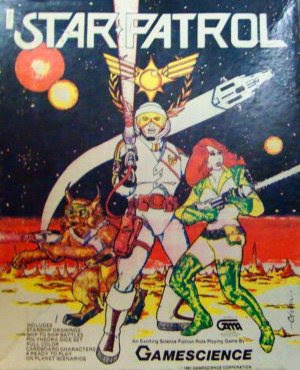 Ugh, I knew I forgot something this week! Fortunately there are still a few days left and as of this moment, no bids!
Here's an auction for the 1981 Gamescience box set of Star Patrol, another iteration of Michael Scott Kurtick's Space Patrol system and very similar to Star Trek Adventure Gaming in the Final Frontier, and the predecessor to Terra Games' 1982 Starfleet Voyages.
The listing says "1977", but the game wasn't released until 1981. The box looks to be in very good condition (better than mine!), and it says it's complete. That should mean a bag of Gamescience precision dice, 67 page rulebook with tables and maps, a big foldout deckplan of a Pioneer-class starship, a hexmap, color standup cardboard characters and vehicle counters.
From the auction listing:
Star Patrol is an early D&D-like science fiction role playing game. Character traits are generated with 3D6. Traits are Strength, Dexterity, Constitution, Charisma, Luck and Mentality. The game had other standard D&D features like psionics and savings throws. Instead of fighter, magic user, cleric character classes, Star Patrol has character professions like soldier, engineer, scientist, astronaut, trader, rogue, and spy/diplomat. Characters can be one of 32 alien races. You can also generate your own weird alien race by rolling against random tables, generating a "general type" (mammal, avian, or even a plant or crystalline derivative), a "general shape" (2, 4, 8, or more legs), size, and even your race's home planet's gravity (low, earth-like, or heavy).
Friday, May 29, 2009
Prime Directive RPG Series - Introduction
 Over the past few months, I've been perusing various publications from the Prime Directive series of role-playing games. For those who don't know, PD is part of the Star Fleet Universe (SFU), derived from Star Trek and the background of tabletop and computer games such as Star Fleet Battles, Federation Commander, Starfleet Command and more. For licensing reasons, the SFU is based on elements of The Original Series, The Animated Series, and The Star Trek Star Fleet Technical Manual, but mostly its own mythology built over decades. In terms of this blog (despite its license with Paramount), Prime Directive may be "not Trek", but it undeniably is a way to role-play Star Trek.
Some fans would disagree. Since the SFU canon diverges so far from Trek canon, PD is often ignored by fans and gamers. Others feel that the SFU is simply too militaristic for "true" Trek gaming. Although I sympathize with both contentions, I think that both arguments are a bit disingenuous. People still love FASA's Trek (the RPG and the Tactical Combat Simulator), but it diverged from canon, built its own mythology, and completely disconnected shortly after the premiere of The Next Generation. And with the exception of some great homebrews, most Trek RPGs over-emphasize combat and can be just as obsessed with martial aspects and details (when compared to the show itself). As gamers and fans, many of us are attracted towards phaser battles, starship design minutiae, combat against an armada of D-7s and so on. I don't think we're as high-minded as we say we are. That does not mean the SFU and PD are beyond reproach and a critical examination. I will state up front that I'm no great or long-time fan of the SFU or Amarillo Design Bureau (ADB). They have a passionate fanbase, but I've never been a part of it. I find the quality and value of ADB's products hit or miss, their website is a mess, and their inability to hit a release schedule aggravating. Also annoying is a decidedly conservative flavor of politics which -- for some unfathomable reason -- they feel is important to broadcast (though perhaps they feel it is reflective of and appealing to their primary customer base).
So I do bring some prejudices to this table (my blog), but now they're out in the open, in advance. As a gamer, my opinion is that they have great potential, but make themselves and their products somewhat unapproachable to the gaming community at large. Nevertheless, although there are a few reasons that PD and the SFU are not for everyone as a Trek game setting, I'm not convinced that some of the criticism leveled at it over the years is necessarily "fair and balanced" (heh). As a result of the resurgence of interest in Trek RPGs and as PD is currently the closest thing to an active Trek RPG license, I decided it could not and should not be ignored on this blog. I was originally going to dive right in to one of the most recent versions of the game, the "Powered by GURPS" version known as GURPS Prime Directive. This was for a few reasons. One, after a few hours of research, it became obvious that it was the only self-contained, economical version of the game. PD D6 does not exist and probably won't exist for some time. PD D20 is confusingly broken up into some products being based on D20 (bad), and others D20 Modern (better), but requiring an expensive out-of-print WOTC book (unacceptable). If I wanted to dive in and get PD and the two supplements Klingons and Romulans, the GURPS version seemed to be the way to go.
GURPS also had the much nicer cover art.
So I bought those, but I also got the D20 Modern version so that I could compare the two on Groknard (I didn't yet know how difficult it was going to be to grab the D20 Modern Core book for a reasonable price). I could always resell both later, I thought. Then I just got silly. I decided I had to get the original 1993 Task Force Games version (pictured above right), and maybe some of those supplements. I ended up getting them all (but at a really reasonable price here and there, probably $25 bucks for all 6 books).
Side note: I've never been the completist collector type, but I'm probably approaching a hundred books and supplements of one sort or another for all six Trek RPG systems, including PD, not including miniatures products. All that's left is one LUG book and a few FASA modules. That's insane. Anyway.
So, as it turns out, I am going to start with a review of TFG's PD1 after all. I actually found it to be pretty cool, if not limited. I wish I'd given it a chance back in the day. That'll be the next part of the series. I'll eventually get around to ADB's GURPS and PD20M versions, but I've got some rarer FASA material I'd also like to get in here soon as well. Maybe by the time I finish it all, PD for D6 (and HERO, and Savage Worlds) will be out. Maybe even some version, any version, of PD Federation.
But as sort of a quickie review, I wanted to share some stuff that came up in a post of RPGnet this week. If you're starting to get bored, you can leave. I won't mind...
A reader there asked about Prime Directive D6: I've been waiting for this for ages. Is anyone around here "in the know" with regards to when we might see this? Or, should I just go ahead and pick up the D20 version (cringe) and get to converting (thus decreasing the already narrow chance I'll get to play it)? He went on to say later that he really had no huge objection to getting a D20 version and converting it to D6. He just didn't want to do it and have the D6 version come out the next day (ha). Also, he asked, had anyone reviewed one of the D20 versions?
A Groknard reader (hi Lee!) turned on the Grok Signal, and this (in part) was my reply:
"...I can go ahead and share my initial thoughts. Just keep in mind that I've read them, not played them.
Initially (as you might suspect from my purchase), I thought the GURPS version was going to be the better purchase. It's "Powered by GURPS", so it's completely self-contained (unlike PD D20M which required me to haunt eBay until I could get D20M). That is an advantage, but not a decisive one. The fact is that the "fluff" of the SFU and additional material -- the included adventure, the art, descriptions of the SFU and species, the deckplans for the trader vessel -- are nearly identical between the two books. GURPS has a few more pages (and smaller type), but it uses them to detail combat, movement, etc based on GURPS lite. I would argue that there is "more game" in PD D20M only because you have to have D20M to fill in the blanks. Of course, you'll spend more unless you already have D20M Core, which is the point.
Obviously, the biggest difference is really in character creation, class-based (D20M) vs point buy (GURPS). IMO, PD D20M has the potential for richer characters ("Rigellian Dedicated Hero Federation Marshall Security Specialist") than the GURPS approach of Advantage - Disadvantage - Skill, and I suspect PD D20M would probably port more easily to D6's template style, but I could be wrong.
It also appears that the D20M version is a little more extensive with details and tables on equipment, and it feels a little better organized. Jonathan (ed: Jonathan Thompson, Battlefield Press), if you're reading this, I think you did a fine job.
Do I regret my GURPS purchases? No, not at all, because I generally don't care for D20, and I like the self-contained lite approach of the GURPS books. I also really wanted the Klingon and Romulan books, which were written for D20 but not D20M (though now I wonder if there is much of a difference in crunch), so I leaned towards GURPS.
But, in retrospect, I am genuinely impressed with how well the SFU (and, I'm going to say it!!! STAR TREK! hahaha, sue me Steve Cole! j/k) mapped onto D20 Modern. There's even a few ideas I want to snatch from one system to the other, so I'm happy with all of them (though I wouldn't encourage anyone to buy all I did... it was for my blog).
If you have and like D20 Modern, get PD D20M. If you prefer D20 and/or classes in general, get PD D20M. If money is no object and you accept you'll have to buy D20 Modern for a full game, get PD D20M. It wins by a nose (except for the cover art, sorry!).
I'd say in all other circumstances, you probably want to get PD GURPS. There simply isn't a huge difference in the content to get hung up about it."
I said a bit more and got snarky with the biggest weakness of PD: the lack of rules for starship combat of all things. ADB expects you to run over to another table and start playing Federation Commander or SFB if you run into a D7. That led to an interesting revelation from Jonathan... that I will save for another time! I want to dig into it with TPTB first.
If you're still reading, I hope you enjoyed what was supposed to be my two-paragraph Friday night post. I just remembered there is still laundry in the dryer, the cats are screaming to be fed, and I have to get some rest for Maker Faire tomorrow! Have a good weekend!
Tuesday, April 28, 2009
One Less Frontier
Bummer news today from Gareth-Michael Skarka of Adamant Entertainment. As you may remember in a previous post, I mentioned he was planning on doing a Trek adaptation for Mongoose's Traveller. Looks like it's not to be. From his LiveJournal...
...Cancelled our proposed Traveller sourcebook, Final Frontier: The Unauthorized Sourcebook to the World's Most Popular SF TV Franchise, for several reasons -- first and foremost being the amount of things on my plate at the moment (specifically the effects of the first bullet point, above). The thought of a potential legal scrum was there as well, although admittedly low on the list, along with doubts about potential audience viability. Really, though -- the main thing was that I've got enough irons in the fire right now, and I should be careful not to confuse what I'd love to see as a player with what I should be working on as a publisher.
Still, this could make things more interesting for me should I feel the initiative. I've been working on a lifepath-based character generation system for my Trek adaptation, and it would easily port over to Traveller. If, that is, I felt like going all out and doing something for Traveller. Not sure how I feel about that, especially for Trek and especially when I've actually got some original projects I'm working on as well.
Despite the fact a slot opened up, I'm still not going to call mine Final Frontier any longer, lol.
Got Michael Giacchino's score for Star Trek today from Amazon. It's really wonderful. I think I've listened to it a half-dozen times already. Big review to come, probably tomorrow.
Thursday, April 2, 2009
Hiding a Tree in a Forest
 The only thing worse than an April Fools' joke is the one that no one catches. Hmmph. From yesterday's entry on homebrewed Trek games:
Perhaps the most recent and disturbing homebrew is based on WOTC's D&D4E. Although I can see the appeal of a cross-genre "phasers vs. magic" style adventure, the conversion only provides stats for four characters: Kirk (Leader), Spock (Controller), McCoy (Defender) and Sulu (Striker). Furthermore, the powers are all combat oriented (i.e., the At-Will "Vulcan Nerve Pinch"), making Dungeons & Dragons: Final Frontier not very Trekish at all, and a rather foolish endeavor.
Well, that's the last time I try to have fun with you guys. In fact, I'm tempted to write it just to spite you all.
Wednesday, April 1, 2009
Homebrewed Star Trek RPG Adaptations (Part 2)
 If there's anything more numerous than commercial adaptations of Star Trek as a role-playing game (Part 1 of this series), it's homebrewed versions and resources written by fans, doing it for themselves using their favorite system.
There's also a lot of them called Final Frontier (guilty as charged).
This is by no means a comprehensive list. In the last post, readers mentioned a homebrew based on R. Talsorian Games' Interlock system, I thought I'd read of one using Chaosium's Basic Role-Playing and I'm sure there are many that never got posted to the Internet at all. D6, Unisystem, Action!... after finding all of these, I suspect there have been nearly as many custom Star Trek games as there have been generic RPG systems.
If you're just interested in converting from a licensed system to one of your favorites, a good place to start is where Owen E. Oulton (of Memory Icon) created a System Conversion Table as part of his own Star Trek Universe campaign. It features guidelines on conversion between various game systems such as ICON (Last Unicorn Games' Trek RPG), FASA's Trek (2E), Traveller (various), GURPS, Star Wars (D6), GDW's "House Rules" system (as used in Twilight: 2000 and Traveller: The New Era) and Babylon 5 (Chameleon Eclectic's The Babylon Project RPG).
But if you're looking for complete conversions by a man who knows his stuff, then you should head directly to the site of the Original Final Frontiers, that of Bob Portnell, King of Star Trek Homebrews (my words, not his). Like me, Bob's love of adventure gaming goes back to The Fantasy Trip and, like me, is "one of the last of the Baby Boomers or the first of Gen X, depending on whose math you use" (his words, not mine). He has not only written extensively about RPGs, but went on to team up with Guy McLimore and Greg Poehlein (co-authors of FASA's Star Trek The Role Playing Game) to co-author the Simply Roleplaying! game as part of their MicroTactix Games endeavor in 1999.
And when it comes to writing Trek games, Bob's got 17 years under his belt so far. In addition to resources like Speed-Trek (notes for faster character creation in FASA's Trek RPG), Bob has written a number of Trek homebrews ("I've been writing Star Trek rules for so long, I can't stop!" he says). While he's working on finishing EZFudge Final Frontier, you can check out his PlainLabel Final Frontier for the Simply Roleplaying! system (core SR! rules free from DriveThruRPG).
Bob's also done two versions of Final Frontier for 3E versions of Steve Jackson Games' GURPS: GURPS Final Frontier (160k zip file with HTML and TXT), and the more compact Final Frontier (2.1 zip with PDFs) based on GURPS Lite, which is included. His GURPS page includes some other resources as well.
I have to say that I really like FF for GURPS Lite (and I'm not at all fond of full-blown GURPS). It's very self contained, well-written and produced, and it's the one version out of all these games that I talk about -- pro or home -- that I would grab for a pick up session or to introduce someone new to RPGs through Trek. Bob's great strength in all of these is that he focuses on the elements that are most like Trek on the screen, and he presents it succinctly. The rules never get in the way, but his approach is not that of narrative games. The tools he provides give players the ability to quickly learn then play a game in the Trek universe that balances cinematic with (not against) realism. That's a hell of an achievement for free games, and similar to the model we've seen executed with the GURPS Dungeon Fantasy series. I'm planning on interviewing Bob here in the near future.
Curiously, there's a number of other homebrews that have been based on the GURPS system over the years:
GURPS Trek - The Unauthorized Sourcebook was a popular homebrew for GURPS 2E from 1996; "Mr. B's" original pages (text file format) can be found here and elsewhere.
GURPS Star Trek (for GURPS 3E?) features pages of races, starships, equipment and campaign notes (note, however, that the links to the Online Character Generator are broken).
GURPS Trek at the Traditional Games Wiki (GURPS 4E) provides a lot of stats, but is unfinished and hasn't been updated in 2 years.
If GURPS isn't your thing, there's Spirit of the Final Frontier, based on Evil Hat's pulp adventure RPG Spirit of the Century, which is not to be confused with Spirit of the 24th Century which ran at a few cons, but is also based on the FateRPG system, which itself is based on Fudge... feel free to stop me at any time. And check out the separate Evil Hat Productions Wiki entry on "Pulp Characters from Books, Movies, etc".
Star Trek for the D20 System is an active Yahoo Group focused on (what else?) adapting the series for D20-based systems such as d20, d20 Modern, PD, True20 and more. There's a number of resources here, though only one completed set of rules which can also be found at...
TrekRPG.info, which hasn't been updated in awhile, but features conversion notes for the d20 System, a downloadable draft of d20 Warp, and links to a Traveller: The New Era adaptation called STrav 3 TNE (thanks to Jerry for the pointer).
WOTC's Alternity still lives on the web, and Scott Metz posted his notes about adapting Trek to the system.
Star Trek: Savage Worlds (1.6MB zip file) adapts Trek for Pinnacle Entertainment Group's Savage Worlds RPG, and features a character sheet, edges, weapons and equipment (requires MS Excel). Groknard reader steveraceuk is in the process of taking it a step further at his Savage Star Trek wiki.
Epoch is a wholly original homebrew system by Jonathan Clarke that's closely based on Star Trek, and focuses less on technology and more on a cinematic feel. It uses a D6 dice-pool system, and even provides guidelines for starship combat.
COSMIQUEST! The Very Final Regurgitation is a Risus-based parody of Star Trek by Guy Hoyle with a small set of guidelines for charcater cliches, technology and adventure seeds. There was another Risus-based Trek parody by "Dr Rotwang" (of the blog I Waste The Buddha With My Crossbow), but it's long gone and he doesn't seem to mind, but has posted some new ideas (that still verge on parody).
Speaking of parodies, I should mention Twerps Twek based TWERPS, "The World's Easiest Role Playing System" by Jeff and 'Manda Dee. Twerps Twek (Campaign Module 7) was by Jon Hancock and Niels Erickson and published by Gamescience in the early 90s. To sum up, it came with "the complete stat" for classic NPCs such as Yeoman Randy Jan and Loquacious of the Bore. This was a commercial product (check eBay or Noble Knight Games) so perhaps doesn't belong here, but I was going to have to mention it in this blog sometime. Mission accomplished.
Another "commercial homebrew" has been announced, this time as "Trek with the serial-numbers-filed-off" for Mongoose's Traveller. Gareth-Michael Skarka of Adamant Entertainment has said that he's working on Final Frontier: The Unauthorized Sourcebook to the World's Most Popular SF TV Franchise, described as a "set of rules and guidelines that will allow you to play races such as the Logical Psions, face off against Swarthy Aggressors, enter careers which represent the various service devisions within the Fleet, and boldly go across the galaxy using space-warp FTL engines." This I'd like to see because I've yet to see a Trek adaptation for Classic Traveller, and CT and MGT are pretty close.
Perhaps the most recent and disturbing homebrew is based on WOTC's D&D4E. Although I can see the appeal of a cross-genre "phasers vs. magic" style adventure, the conversion only provides stats for four characters: Kirk (Leader), Spock (Controller), McCoy (Defender) and Sulu (Striker). Furthermore, the powers are all combat oriented (i.e., the At-Will "Vulcan Nerve Pinch"), making Dungeons & Dragons: Final Frontier not very Trekish at all, and a rather foolish endeavor.
Finally (probably not!), there's my own totally non-commercial please-don't-sue-me venture, Thousand Suns: Final Frontier (35 pages, 1.7MB zipped PDF). It's only a preview version from December '08, but I've come a long way since "The Universe Trip" edition of 1981. Still, I'm not sure where I'm going to go with this. Since starting this blog, I'm asking myself, "Does the community really need another RPG based on Star Trek? Especially a homebrew focused on TOS? Especially called Final Frontier??"
Probably not. But I can't help but think that when the new film comes out, some people are going to turn their eyes back to Star Trek and think, "Hell, yeah, I want to play that!" And I love the idea of a Trek game based on Thousand Suns, one that takes place in a period not so constrained by the dreaded "Trek canon", where the future is wide open.
Perhaps, I'm thinking, I should be looking forward as much as I'm looking back...
- - - - - - - -
ADDENDUM #1: I completely forgot one that's the most current of all -- Federal Space (link to wiki). Federal Space is a unique group project started by some folks on RPG.net, and is described as "a decidedly non-canonical spin on the familiar Star Trek universe, refracted through a lens of harder science and (hopefully) more consistent worldbuilding... it's Star Trek: Stand Alone Complex, or Star Trek run at GURPS TL10 (hard science path) instead of TL12 (with superscience), or a pacifistic version of Star Fleet Battles, or simply 'Star Trek with hats.'"
Not my cup of tea, but still, it belongs here more than TWERPS Twek.
ADDENDUM #2: Jerry (below) mentions the FASA Trek Sourcebook for Hero System (5th ed.), at the Star Hero Fandom website, which also includes TNG Hero for the TNG/DS9 era. Very extensive work and templates for Hero Designer software.
ADDENDUM #3: Probably my last update (4/8/09) as this could go on forever, far longer than anyone will actually look at this post! Mike Berkey has composed some rulesets called Where No Man Has Gone Before based on the TOS setting. This is an exceptionally cool document and full of great ideas and random tables (examples: "First Beam In Location", "
Random Interior Set Generator") useful to anyone interested in Trek RPGs, regardless of system. Version 2.0 is the most recent, and based on the Microlite20 system. Version 1.0 is more heavily drawn from d20Modern. Seriously, check it out now, it's a really fun read.
Tuesday, March 31, 2009
Homebrewed Star Trek RPG Adaptations (Part 1)
 One of the more interesting aspects about Star Trek as a role-playing game is how many times it's been "homebrewed" -- adapted for another existing system by players -- despite the fact that there have been nearly a dozen versions of Trek RPGs (for the purposes of this post, I'm including the "not Treks"). To illustrate, here's a list:
- Space Patrol (Gamescience, 1977)
- Star Trek: Adventure Gaming in the Final Frontier (Heritage, 1978)
- Starships & Spacemen (FGU, 1978)
- Star Patrol (Gamescience, 1981)
- Starfleet Voyages (Terra Games Company, 1982)
- Star Trek: The Role Playing Game (FASA, 1982)
- Enterprise - Role Play Game in Star Trek (Tsukuda Hobby, 1983)
- Prime Directive (1) (Task Force Games, 1993)
- Star Trek Role Playing Game(s) (Last Unicorn Games (1998, 1999)
- Star Trek Roleplaying Game (Decipher, 2002)
- Prime Directive (various systems) (Amarillo Design Bureau, 2004 - present)
Nevertheless, there are few other settings that seem to inspire so many homebrews. In fact, I started this blog as a side-effect of re-reading through my own collection as research for my own homebrew, an adaptation of the early TOS years (around Stardate 1500, 2266 AD) for Rogue Games' Thousand Suns. Sometime during that research, I came across a poll that asked Trek RPGers, "Which System Do You Use?" I think it was TrekRPG Forums, but heck if I can find it now! Fortunately, I copied and pasted the results:
CODA.....25...39.1%
ICON......24...37.5%
GURPS.....2.....3.1%
D20..........3.....4.7%
Home......10...15.6%
It's a bit hard to take a poll that didn't include FASA too seriously (and, yes, it's still played and even updated by folks such as Rob Bocchino, as evidenced by his site and other sites still dedicated to it). But, again, not my point. Regardless of the fact that there are already systems out there, over 15% still prefer to roll their own. Why is that? Speaking for myself:
- I like the challenge;
- I like my system of choice (TS's 12° system has a killer way of resolving Tests, especially its use of Resolve for non-combat confrontations);
- I find the other systems to be either too complex for such a cinematic, brains-over-brawn setting like Star Trek, or too dated to support some of the enhancements found in games today;
- I feel that most of the other systems spent way too much time on combat, technology and minutiae such as starship construction. Sure, these aspects can be ignored to some extent, but those decisions end up creeping into other portions of the game (skills, starship combat, task resolution) at the expense of things I feel are more important to Star Trek (exploration, moral conundrums, action rather than combat).
 I did my first Trek homebrew in the summer of 1981. I had a distinct talent at the time for falling in love with games that were doomed to obscurity *. Neither Dungeons & Dragons or Traveller inspired me much after the first few years. For fantasy I gravitated toward Metgaming's The Fantasy Trip system (Melee, Wizard, In the Labyrinth), Steve Jackson's precursor to GURPS. In 1981, Universe was released as SPI's answer to science fiction role-playing games. TFT gave me the crunch, some articles from Space Gamer and Interplay magazines gave me sci-fi technology, and Universe provided inspiration for skills, exploration and aliens. With a pen and a legal pad I set forth creating my first homebrew, which I think had FEDERATION scrawled at the top.
* to be fair, I fell hard for Chaosium's Call of Cthulhu, too, so it's not like I have a curse or anything
By the end of that summer, my friends and I sat down to play my adventure. It had something to do with the Enterprise finding itself trapped in a void, a castle, robot guardians and probably had more than a passing resemblance to the Doctor Who story "Warriors' Gate". I don't recall the specifics, but I don't think it went well. Sadly, the legal pad is long gone, its pages stored in the Universe box which went in one of many yard sales I've had over the years. I've since recovered Universe, but if you happen to come across those yellow pages, please contact me.
Coming up in Part 2: a look at various Trek homebrews from over the years with links to those that are available
But wait! There's more.....
Monday, March 23, 2009
LUG Treks - The Lost and Untaken
 Next to the FASA system, my favorite of the Trek RPG systems out there was that of Last Unicorn Games. Although its ICON system was a bit unusual, the rules were presented clearly and had a simplicity that the other games lacked, in my opinion. And it really feels like Star Trek. Some may disagree with their approach -- that is, releasing separate core books for TOS, TNG and DS9, leading to duplication and making it expensive to be a completist -- but when I compare it to Decipher's one-size-fits-all approach, I think LUG came out ahead.
Unfortunately, the strategy backfired when LUG was cut down in its prime in 2000 by its own finances, the Wizards of the Coast acquisition, and the subsequent granting of the Trek license to Decipher. As a result, a number of key parts of the Star Trek universe that were planned to be detailed by LUG never saw publication.
Thanks be to the Prophets for the Internet.
If you're a long-time LUG fan and player, you probably already know about the "lost" LUGTrek material. But if you're new to the hobby or just now picking up the books from eBay or online retailers, you'll want to check into these sites that have additional resources available for the game, and give you a glimpse of nearly half of the books that never saw the light of day*. Regardless of your favored system, these sites are well worth bookmarking and checking out.
Untaken Treks: The Unpublished LUGtrek Work of S. John Ross - SJR is one of the best writers and designers in the RPG industry. He's contributed to GURPS, WOTC and others, and for LUG wrote the fantastic Star Trek: The Original Series - Narrator's Toolkit and co-authored Among the Clans: The Andorians and others. Untaken Treks is the collection of his unpublished material for the LUGTrek RPG, and features draft excerpts from books such as Final Frontiers: The Star Trek Films, Sky Princes of Orion, The Klingon Empire: Blood and Honor, The Starfleet Exploration Handbook: To Boldly Go and more.
Steve Kenson's Star Trek: The Lost Episodes - Despite his insanely long CV, Steve is probably best known for Green Ronin Publishing's d20 superhero game Mutants and Masterminds and the True20 roleplaying system. As part of the LUG writers pool, he was a contributor to the DS9 Roleplaying Game, Planetary Adventures 1, and the box-sets The Way of D'era and Starfleet Academy. The Lost Episodes features his unpublished contributions to The Cardassian Union: Iron and Ash, The Klingon Empire: Blood and Honor, The Starfleet Security Handbook, and Through a Glass Darkly: The Mirror Universe and more.
Finally, I would be remiss if I didn't point out Owen Oulton's wonderful Memory Icon, part of his Adventure Gaming in the Star Trek Universe website. Here he hosts the Official Last Unicorn Games support materials, official errata, and many fan creations. Perhaps most notable is SpaceDock! by Steve Long (HERO Games), a collection of rules and resources based on what was planned to be part of the books The Starfleet Starship Construction and Ship Recognition Manuals. Despite the dissolution of LUG, Steve kept working on the texts, and the end result is an incredibly complete and professional set of PDFs -- hundreds of pages that cover nearly everything from TOS to the Dominion War, all for free.
For a "dead system" LUG's Star Trek Roleplaying Game has more life and depth to it than many living, breathing RPGs... all thanks to the talents and contributions of these generous individuals.
* According to Memory Alpha, the Star Trek Wiki, Last Unicorn had planned the following books:
- Final Frontiers: The Star Trek Films
- The Star Trek Guide to Parallel Planets: Hodgkin's Law
- The Klingon Empire: Blood and Honor
- Operation Stormbird: The Neutral Zone Campaign Vol. 2
- The Starfleet Exploration Handbook: To Boldly Go
- The Starfleet Security Handbook
- Call of the Prophets: The Bajorans
- Dominion War: The Fires of Armageddon
- Merchants & Traders: The Latinum Main
- The Cardassian Union: Iron and Ash
- Through a Glass Darkly: The Mirror Universe
- The Starfleet Starship Construction Manual Vol. 1: Spacedock
- The Starfleet Starship Recognition Manual Vol. 1: The Ships of Starfleet
- The Borg
- Deep Space Nine Player's Guide
- The Orion Syndicate
- The Rigel System
- The Dominion Companion
- Star Trek: Voyager Core Game Book
- Sky Princes of Orion
Saturday, March 21, 2009
Heritage's Star Trek RPG In-Depth (Part 2)
 Today I'm going to wrap up my in-depth review of the rulebook for Heritage's 1978 Star Trek Adventure Gaming in the Final Frontier (STAGFF), then move on to fan written works that added to the original game. In Part 1, I covered the Basic Game rules and scenario. To sum up my findings so far:
- STAGFF is better organized and presented and more playable than its predecessor, Space Patrol.
- The Basic Game is based upon using the classic Trek characters (Kirk, Spock, Koloth, etc.) and provides stats for them.
- For the most part, the Abilities -- Strength (ST), Dexterity (DX), Luck (LK), Mentality (MN), Charisma (CH), and Constitution (CN) -- are each applied to only one or two specific tasks with modifiers. No Skill system is given.
- The game suffers from unnecessary complexity.
- The Basic Game provides a brief Scenario called "The Shuttlecraft Crash" and includes a map.
- Even in comparison to the few other RPGs of the time, STAGFF feels more like a wargame, and feels nothing like Star Trek itself.
Over 1,000,000,000 years ago the Slavers ruled the Galaxy. They died off when one of their subject races rebelled with sufficient ferocity. The only known remains of the last Slaver Empire are Stasis boxes. These are special force field boxes in which time stands still. These boxes can be opened using a magnetic probe and they often contain artifacts, devices and other remains of the lost Empire. Just such a box gave the Federation its anti-gravity technology used on starships. Another stasis box contained a super-weapon that was lost due to Kzinti intervention. The slaver stasis boxes are the most sought after archaelogical treasures in the known universe.
The scenario opens with the ENTERPRISE shadowing an alien vessel traveling in unknown territory. The alien vessel, possibly a Kzin or Klingon ship (this is at the discretion of the Mission Master. Any aliens can be used. When aliens are mentioned in this scenario they will be called aliens, but the Mission Master can fill in whatever aliens he thinks would be appropriate) makes a landing on a small Class M world near a partially ruined building. The alien crew, numbering 8 individuals, are seen getting out and entering the building. The ENTERPRISE sends down a party of 6 crewmen to investigate.
 The planet has been seeded by the ancient race known as the Providers and has animals from many parts of the Galaxy. The building in the ruins is an ancient Slaver outpost and contains 4 stasis boxes hidden within its walls along with various creatures and the searching alien landing party. The Star Fleet crew must prevent the stasis boxes from falling into the hands of the aliens. The walls of the building are made of a Slaver alloy which prevents the operation of the communicator (and thus the Transporter) and tricorder readings are only partially effective through its walls. Doors in the building are sliding doors requiring a strength of at least 13 to open or can be burned down by a phaser set on Dematerialize. The aliens are hostile and will attack the Federation crewmembers on sight.
So that's kind of cool. A sequel of sorts to the 1973 Star Trek animated series episode "The Slaver Weapon" by Larry Niven, and author Michael Scott even got Kzin/Kzinti correct! And an adventure on a planet seeded with the remnants of both Slavers and Providers? All it needs are the Ringers from the Enterprise RPG scenario "The Drifting Ring", and we'll have all the Ancients covered.
In all seriousness, a few things worth noting. First, the "dungeon crawl" nature of the mission is pretty obvious: kill the Kzinti, find and take the treasure. It feels more like a D&D adventure than anything actually inspired by a Star Trek episode. Second, here is evidence that as early as 1978, the question of how do deal with the Transporter in a Star Trek RPG is identified as problematic (and still discussed today, as shown in one of this week's more popular threads on RPGnet). Prospective GMs take note: "Slaver Alloy" as an alternative to "Ion Storm". Third, I do find it interesting that there are some similarities between this Scenario and the one included with the Japanese RPG Enterprise (ancient race, stasis devices)... I wonder if Tama Yutaka had actually seen this game before he was inspired to write his own years later?
The Scenario is more interesting than the one in the Basic Game, and much more deadly. It makes use of the elements from the Advanced Game such as Psionics and some of the new creatures listed later on including the Capellan Power Cat, the Vulcan Sehlat and... the Mugato! Those whacky Providers.
The Scenario is followed by a brief section on custom Character Creation, which basically consists of rolling various dice for the six primary Attributes, the all-important Size attribute (right down to the centimeter) and Movement. The rule for awarding experience essentially amounts to two sentences, encouraging the Mission Master to award Attribute points and new equipment training for a successfully completed scenario.
The section on Psionics makes it clear that, with the exception of Vulcans and the Kziniti, characters will rarely have a Psionic power, determined by a roll (1% chance). If the roll succeeds, they roll to get Empathy (with a rule for Gem-like healing), Telepathy, Telekinesis, Clairvoyance, Precognition, Mind Control or Teleportation. Again, this section is very similar to the PSY Talents section in Enterprise. I suspect the list was influenced by Traveller Book 3 - Worlds and Adventures, but the random generation method looks to be Michael Scott's own, later borrowed and further polished by Yutaka. It's definitely not the Psionics of Eldritch Wizardry.
 The next section is on Familiar Star Trek Life Forms, a list of nearly 50 alien races and creatures from both TOS and TAS. Examples (note the use of the generic AR - Ability Rating - for creatures as opposed to alien races, as detailed in the Basic Game; note also, typos are not my own):
MUGATO - Great white horned ape of Neural with poison fangs. They mate for life and will avenge mate's death. Basic move: 12, Basic size: 250 cm, AR 18.
TELLARITE - Pig-like humanoids, they are members of the UFP and can be members of a Star Fleet crew. They are very argumentive and alcohol only makes them more so. Basic size: 175cm, Basic move: 10m, CH -2.
VULCANS - Pointed-eared humanoids of great emotional control and logic. Their blood is based on copper salts and they have protective nictating membrances to protect their eyes from dirt and glare. They have limited powers of telepathy and empathy in that they usually have to be in contact with a subject for the powers to operate. Once every seven years they must mate or die. Basic size 200cm, Basic move: 11m, ST +3, DX +2, MN +3, CT +4. They are members of the United Federation of Planets (in fact, one of the most highly regarded members) and are found throughout Star Fleet's crews. The Vulcan Spock is a successful hybrid of Vulcan and Human heritage.
Rules are also provided for Creating Alien Creatures, based on Space Patrol's random attribute generation method (3D6 for AR) and a series of tables: Type and Shape, Size, Special Capabilties, Size Modifier and Basic Movement.
The next sections are the Advanced Equipment Table and a 4-page List of Equipment and Weapons, many based on Star Trek items (ex: Lirpa, Phaser Bore, Phynburger (sic), Universal Translator, five types of Tricorders), and the rest corresponding roughly to that provided in Space Patrol. These are generally just descriptions with little or no detail as to their effects, provided later in the Advanced Game Weapons Tables that are part of Advanced Combat.
The Advanced Combat Rules don't add much to what was outlined for ranged and hand-to-hand combat in the Basic Rules. In fact, despite the four pages they occupy, the Advanced Rules really only add three things: a modifier for Initiative (or, as it's called throughout the book, "Initiation"), tables for the use of all the weapons previously introduced, and rules for the use of Armor and Shielding (in short, the value of the Armor Rating is subtracted from the damage when hit).
The book starts to wrap-up with simple instructions for creating custom Scenarios, re-uses Space Patrol's types of scenarios, and throws in a few Trek-ish bones into each such as this:
You may have realized that the players of a scenario do not have to be Star Fleet crewmembers. They could be Klingons, Romulans, or some other race. Think how nice it would be sometime to be able to solve a problem technologically and not be hampered by the Prime Directive restricting your every action. Admittedly the Star Fleet crew has the harder job, having to play by the United Federation of Planets' rules and still get the job done. But Kirk seemed to manage from week-to-week, and you can too.
It then gives some advice to the prospective Mission Master on how to keep players engaged by emphasizing the mystery to be solved in the story, and how to deal with players in general. This also leads to one of the stranger passages of the book:
(T)he Mission Master does not volunteer answers to questions that are not asked... Suppose that Spock was using the semi-sentient talking computer of the ship systems to scan an area . He asks for the computer to report any relevant dangers. It would be asking too much of the computer to understand Spock's unreasonable fear of the Groupies at a Star Trek convention. Thus, unless our favorite Vulcan asked, the computer would see no reason to mention his adoring fans waiting in the landing area.
 Both of these excerpts are examples of a few places in the game where you may sense a little disdain for Star Trek itself, but I think it's worth noting that STAGFF is really a product of its time.
First, it was 1978 and, in the wake of Star Wars, repeats of Star Trek were starting to feel a little dated. Yes, a big film was on its way in late 1979, but little was known about it. Star Trek and "Trekkies" were seen as cheesy and as objects of derision, even more so than today (for example, the 1976 SNL sketch with John Belushi as Kirk, and Mad magazine's Trek parody later that same year). The way I recall it (and I was only in my early teens in the late 70s), it really wasn't until the films and the Next Generation shows that Trek (even TOS) began to gain some wider respect in pop culture.
Second (and I've mentioned this before), 1978 was early for RPGs, which were still growing out of their wargame origins. The fact that STAGFF was created (probably on the cheap) only to help Heritage Models sell its Star Trek miniatures emphasizes that "role" was still being defined in gaming. At that time, it was probably inevitable that such a game would turn out to be "let's phaser things and take their alien treasure!" As a result, STAGFF is really just a great big list of things to kill, weapons to kill them with and the mechanics to do so.
I'd argue that things haven't improved much in this regard over the past 30+ years. Despite the noble efforts of FASA, LUG and Decipher to emphasize elements in their games such as diplomacy, the Prime Directive, character skills and "the needs of the many", the fact remains that the Trek games that have survived and done best over the years (tabletop or computer-based) are those that are focused on starship combat and "let's phaser things and take their alien treasure!" There have been a number of online discussions lately as to whether Trek is really suitable for roleplaying at all, especially when you have players (and GMs?) that focus on Trek-nology and do things like transport a photon torpedo over to the enemy's bridge (RPGnet thread).
I'm not trying to philosophize (not yet, that'll come later). I'm just pointing out that the easiest criticism to level at STAGFF -- that it's "not very Star Trek" -- is still true of Trek games today. In 1978, I'm not sure that mattered or offended all that much. And despite these strange passages in the rulebook, their are other places where you can tell that the author must have loved the show. For what was probably supposed to be a simple miniatures game, he went a little further than just slapping the name "Star Trek" onto his Space Patrol rules.
The rulebook finishes by referring the reader to the best merchandise available at the time: books! In the days before VHS and The Google, references such as The Star Fleet Technical Manual, The Star Trek Concordance, The Making of Star Trek, and the novelizations of TOS and TAS would be a Mission Master's best friend. At the bottom of the page was the "Star Trek Catalog" of Heritage Models: the list of 31 packages of miniatures, half of which would never go into production.
The most notable elements missing in this Star Trek game are the things that Michael Scott would later remedy somewhat in Star Patrol and Starfleet Voyages: the themes of exploration, character building, starships and starship combat. Although a comprehensive approach wouldn't show up until FASA's 1982 Star Trek The Roleplaying Game, this is not the end of the STAGFF story. Two fan-written works published years apart in Different Worlds magazine would take two very different approaches to extending STAGFF, and make it more like the Star Trek game they wanted it to be. I'll look at those in the near future.
But wait! There's more.....
Trek RPG Auction of the Week - 3/21/09
 I'm finishing up my piece of Heritage's Star Trek RPG (and laundry), and here's its daddy on eBay: Lou Zocchi presents Space Patrol by Michael Scott Kurtick and Rockland Russo, released by Gamescience in 1977. It went on to spawn various games: Heritage's Star Trek: Adventure Gaming in the Final Frontier (1978), Gamescience's Star Patrol (1981), and Terra Games' Starfleet Voyages (1982).
Although not officially licensed, Space Patrol made some tongue-in-cheek use of the terminology and setting of Trek, referencing Kirk, phasers, Klingons, landing parties and so on. At the same time, its ambitions went beyond Trek-with-serial-numbers-filed and also included references to Niven's Kzinti, Asimov's Foundation, Heinlein's Starship Troopers, Flash Gordon, Pournelle's Falkenberg's Legion and -- in a last minute addenda -- the new kid on the block, Star Wars.
Not a great game, but definitely a piece of RPG history, and a less expensive way to get virtually the same rules as the first Trek roleplaying game.
Friday, March 13, 2009
Trek RPG Auction of the Week - 3/13/09
 Just a quick entry for Auction of the Week, a little earlier than ususal. If you've been looking for this, I didn't want you to miss it:
STARFLEET VOYAGES
The Final Frontier holds Danger and Adventure for those who volunteer for STARFLEET VOYAGES!
A complete roleplaying system for interstellar adventure including a separate starship combat game with color counters.
Publisher Terra Games Company (1982), designed by Michael Scott (this copy signed by the designer!)
As briefly covered here in one of my first entries, Michael Scott Kurtick released this game, called Starfleet Voyages, which is esstentially the 4th and final version of Space Patrol. Which makes it sort of an 3rd version of Heritage's Star Trek: Adventure Gaming in the Final Frontier, and includes most of the same material but adds starship combat.
Despite it being a not-so-thinly-veiled unlicensed Star Trek game, I'd say it's arguably the best of his games in almost every respect. As any of them are notoriously difficult to find, this is a great opportunity to get your hands on one. Good luck!
Wednesday, March 11, 2009
New Prime Directive RPG Releases from ADB
 Looks like the folks over at Amarillo Design Bureau have been super busy lately, and there are a few upcoming releases of interest. I said early on that I probably wouldn't cover the Star Fleet Universe or its Prime Directive RPG much here, but I've changed my mind for a number of reasons.
Primarily, Stephen Cole and ADB have kept the flame burning for Trek tabletop gaming for a long time, 30 frakkin' years! That deserves nothing but respect. Some of the themes and tone of the SFU may differ from Star Trek, but it's properly licensed and the rest is technicality. If my blog is truly "A Retrospective of Star Trek RPGs", then it's incomplete without coverage of these efforts.
I'll also be covering SFU over on my new Tabletop Games column at Star Trek Games, as games such as Star Fleet Battles and Federation Commander have probably had a bigger impact in terms of Trek-themed tabletop gaming than anyone else.
Anyway, news!
Scheduled for 4/20/09: Prime Directive: Federation (d20 Modern), SKU 8702, $24.95 - This manual covers everything you could want to know about those do-gooders of the galaxy, the Federation. Extensive history of the Federation, history and culture a dozen member races, military organizations, medals, starships, politics, intelligence agencies, etc. This release is specifically for the d20 Modern rule system, and PD20M core rules and supplements for the Klingons and Romulans are already available. UPDATE: Thanks to Stephen Cole at ADB for sending me the cover images above and below! Scheduled for 5/18/09: The long-anticipated GURPS Prime Directive: Federation, (GURPS 4E), SKU 8402, $24.95 - Similar to the above, but adapted to the Generic Universal Role Playing System by Steve Jackson Games. The Core PDGURPS book (200 pages, and includes a complete rules set for GURPS including character creation) and supplements for Klingons and Romulans have been available for awhile. Other supplements such as Tholians and Starships have been mentioned in the past, so hopefully the release of Federation is a sign that things are picking up steam.
Keep an eye out here for more on the past, present and future of Prime Directive.
Saturday, February 7, 2009
Trek RPG Auction of the Week - 2/8/09

One of the best Trek RPG supplements ever written, so good it influenced one of the series (Enterprise). Sadly, the only supplement (other than The Narrator's Toolkit) released by Last Unicorn Games for its TOS version of Star Trek Roleplaying Game. A useful resource for any of the Trek systems for one of the more neglected species of the Trek universe.
Star Trek RPG Last Unicorn Games Among the Clans - The Andorians
by the incomparable S. John Ross, with Steven S. Long and Adam Dickstein.
Shows up less and less on eBay these days. For complete details, check out the Memory Alpha wiki entry on this great book.
Wednesday, January 28, 2009
New Star Trek Games... No RPG
TrekMovie.com today posted an article about the mass of licensed Trek junk merchandise about to be dumped upon the unsuspecting public in anticipation of JJ Abrams' Star Trek movie. Oh dear, it looks like The Phantom Menace all over again (hint: wait two years... folks on eBay won't be able to give it away!).
Not surprising is the sheer amount of licenses issued solely to Trek tabletop gaming: more Trek Monopoly, UNO, the Scene It DVD boardgame, a trivia game, Scrabble and -- of course -- Star Trek Magic 8 Ball (FTW?!?!). Okay, I guess that is surprising after all.
What else is surprising? No Star Trek Roleplaying Game, for either the classic series or the new movie universe. Decipher lost the license a little over a year ago and at the moment no one has the license. A little bird over on theRPGSite Forums says that inquiries have, in fact, recently been made but apparently CBS Consumer Products is not interested at this time. Which is very sad, and makes Mr. Spock cry. It's no secret that Decipher and Last Unicorn Games faced two big problems when doing their respective versions of a Trek RPG. One, neither company was very good at running its business, regardless of the burdens of the Trek license. Two, both were releasing Trek RPGs at a time of "Trek Burnout". When even fans were turning their backs on the shows and films coming out of Paramount, it's hard to imagine the associated merchandise doing much better. Admittedly I've never seen the books of any of these companies, but I'd find it hard to imagine that FASA was able to do Trek for such a long time and with a wealth of material if they weren't doing so as a going concern.
Different times, of course, and there are some who question whether or not Star Trek is even suitable for tabletop roleplaying in this day and age. That seems to be a debate that comes up every once in awhile over on RPGnet and other places. My opinion: given the right timing, the right business approach and a well-developed game, there's no reason that a Star Trek RPG couldn't be a critical and popular success all over again.
In the meantime, we can always continue with what's already out there, and even "roll our own" for our favorite RPG system (see my 2MB preview version of Final Frontier, the Trek adaptation for the Thousand Suns RPG that I've been working on lately). I have to admit, though, that there would be nothing like strolling into my FLGS and finding a brand spanking new official "Star Trek RPG Core Rules" game on the shelf and a rack of minis right next to it.
There's always hope. And until then, there's Star Trek Magic 8 Ball.
Tuesday, January 20, 2009
Space Patrol (Gamescience, 1977)
 "It is up to the judgement of the Game Master to decide the suitability of a character to a particular scenario. For instance, a Klingon is unlikely to be a member of a Federation landing party." - SPACE PATROL, "Creating Characters", page 2.
As detailed previously, Gamescience's August 1977 release of Space Patrol by Michael Scott Kurtick and Rockland Russo was the granddaddy of Star Trek roleplaying games. Although not officially licensed, it made some tongue-in-cheek use of the terminology and setting of Trek, referencing Kirk, phasers, Klingons, landing parties and so on. At the same time, its ambitions went beyond Trek-with-serial-numbers-filed and also included references to Niven's Kzinti (who themselves had made a guest appearance in the animated Star Trek series), Asimov's Foundation, Heinlein's Starship Troopers, Flash Gordon, Pournelle's Falkenberg's Legion and -- in a last minute addenda -- the new kid on the block, Star Wars.
In other words, Space Patrol was striving to be a definitive adaption of the space opera genre for RPGs. That was pretty ambitious for a 38 page rulebook, especially when you consider that only 14 pages of that are actual rules text (without tables and illustrations), albeit in three columns of 8pt type. Space Patrol wasn't the first or only attempt at that time to create a "sci-fi D&D". 1976 had already seen the releases of TSR's Metamorphosis: Alpha and Flying Buffalo's Starfaring, and Tyr's Space Quest, FGU's Flash Gordon and GDW's definitive science fiction RPG Traveller would follow in 1977, around the same time as Space Patrol itself.
(aside: for a great look back at Classic Traveller, see today's post over at Grognardia)
And, as mentioned in previous posts, Space Patrol would evolve over a number of years as the basis for Heritage's Star Trek: Adventure Gaming in the Final Frontier (1978), Gamescience's Star Patrol (1981), and Terra Games' Starfleet Voyages. I think it's worth re-iterating this upfront because the playability of the game started off rather rocky, but improved to become a more fleshed-out system by the time it was released as Starfleet Voyages.
Despite (and perhaps in part due to) its ambitious intentions, Space Patrol is a prime example of how rules can get in the way of having a good time. In fact, the most fun probably comes from reading the rulebook itself, which is peppered throughout with amusing jabs at the genre that it's supposed to be emulating. Although this -- that it never takes itself too seriously -- is part of its charm, the system itself gets bogged down in unnecessary complexity, rules exceptions, and a necessity to refer too often to poorly implemented tables. The problems with Space Patrol can be summed up as follows: its wargame approach, its presentation and its organization.
First, Space Patrol is very much a miniatures-based and combat-oriented game, and can likely only be played using figures or counters on a grid (not included). The first sections detail character creation by rolling 3D6 to determine the basic attributes: Strength, Dexterity, Luck, Constitution, Charisma and Mentality. The values of these stats generally determine a value or modifier for task resolution. If the attribute is from 9 to 12, there is no modifier. For each point under 9, the player will subtract 1. For each point over 12, the player will add 1. Sometimes the resulting value will require consulting a success probability table, requiring another role on percentile dice. Sometimes it will be compared to an opposed value, such as the defender in combat. Sometimes it will become a factor in further calculations, such as the use of the telekinesis psionic power. The "less than 9, more than 12" system is very consistent, but what happens next is not, depending on the specific task.
Further, Charisma and Mentality really don't figure into the rules much further, and Constitution is almost exclusively a hit point metric. The game presents no economic scheme, no real career, skill or experience systems, and no starship rules at all. As a result, Space Patrol feels like little more than a man-to-man combat system for landing parties than a true roleplaying game.
Second, even for the time, the presentation of the rulebook leaves a lot to be desired. Mediocre artwork unrelated to the text, typos and primitive layout were not at all uncommon in games at the time (I would argue that it can be part of the old school gaming charm). But in this case, the production values and choices really get in the way of simply absorbing the rules. The type is extremely small, the three column layout does not suit the complexity of the text, a great deal of space is wasted (many tables are repeated three times!), and the 25+ tables (so necessary to the game) are at times indecipherable due to use of shorthand. Again this is not uncommon in older games, but more often than not there is enough explanation within the body text to understand the authors' intentions. In the case of Space Patrol there were times when I just had to give up and refer to the 1982 Starfleet Voyages book to decipher some passages.
Third, the rules are very poorly organized. "Creating Characters" is followed by "Creature Creation", "Psionics", "Gravity", "Movement", "Equipment", "Learning" and so on in that order. Important concepts are introduced, described in part, dropped, and picked up later or not at all. The seeds for a really good game are there, but there are few games from the period that could have benefited more from a good editor and (I suspect) the word processing revolution.
One last note, more a curiosity than a criticism. The writing itself is very casual, but I think the authors' antagonistic attitude toward players shows through in a few places. For example:
"We have seen other games with loosely structured formats which, because of local optional rules, became almost unrecognizable from one group to another. We have seen players travelling from one city to another feeling ripped off when trying to play in a new environment until they learn the local options. Thus we ask that you not mess with the rules but rather tell us about your ideas. The rules and corrections that we like will be included in a supplement or sister editions as practical. Thus, hopefully, no one will snivel when playing with new people because of surprise rules."
Which would be fine (well, not really) if the game didn't require house rules to be playable. Then there's this classic from "Creating Characters":
"We recommend that the Mission Master allow only characters personally known to him to be played. This is because we have seen much to offend the honest player in other role-playing games. We have seen other players use characters which some time in the past have been purely fabricated with unusual abilities, or a super character who has been done away with in other 9ames but not left-to-lie in peace. We have also known people who are fond of sitting down and generating some 20 or 30 characters and then throw out all but those who are unusually good. They then claim that all the characters in their stable were in fact, randomly generated."
Sheesh! Seriously, this game would be nearly twice as good if they'd simply used that space to explain "RADIUS or RANGE OF EFFECT/DICE". I'm not sure I've seen so much editorializing in such a small game.
Having said all that, there is good in this game, I feel it. As I mentioned, it really doesn't reach its full potential until Starfleet Voyages, but it does get much better (especially in terms of presentation and organization) as soon as Heritage's Star Trek: Adventure Gaming in the Final Frontier. It still doesn't feel like Star Trek, but I think that very concept was still being defined in the mid-70s. Amongst the real gems in the rulebook for old school science fiction gaming:
Space Patrol is worth tracking down and picking up (at a very reasonable price) if you enjoy odd RPG curios from days-gone-by. But don't expect to be able to play it, and don't expect it to be a good match for a Star Trek game, even of the old school variety. For that, look to the later versions of the game, which I'll be covering in this blog shortly.
Tuesday, January 13, 2009
Context
Following last night's rather snarky post about Starfleet Voyages, it occurred to me that I should make a post regarding the games I'm discussing, and context.
First, the context of time. Most of what I'm discussing here are products from 1977 - 1982. The quality of games and their design, components, layout, and artwork varied wildly during this period. The desktop publishing revolution had barely started and few companies at the time had the resources to publish product anything close to what we see today. Frankly, I find that part of the charm of all of these games. They feel more personal, blemishes and all. Typos and outright rules issues were inevitable, and there was no internet community to provide and share real-time feedback. And errata? Pfft. If it existed, you had to hope it would get published in a magazine you happened to read, or send a SASE off in the hopes of getting one. And game mechanics at the time could be, in comparison to today, fairly primitive and/or complex. Games seem much more elegant these days in some respects, but the beauty of many of these old games is how much freedom there was for players to fill in the blanks. Heck, the very nature of RPGs and what made good roleplaying was still being defined and emerging from its wargame roots.
Second, the context of Star Trek itself. We had only syndication and a fading memory of the animated series. The Motion Picture didn't come out until December 1979. For awhile, we weren't even sure there would be another movie. The Bantam original novels were still few and far between. There was no Next Generation. There was no canon. And Star Wars was kind of overshadowing Trek anyway, and in the process redefining licensing, merchandising and the concept of franchise. Again, there was a lot of freedom, and designers and publishers were taking advantage of it in ways they couldn't today.
Finally, the context of my sense of humor. If I come off as sarcastic about these games at times, it's only through the eyes of a smartass 43 year old. When I was 13 I wasn't nearly as critical, at least not about games. My friends and I just took whatever we were given, ran with it and had fun. Although I pretty much knew something was seriously wrong about THAC0. The truth is that I pretty much love every one of them, no matter how rough they might be. Otherwise I wouldn't be doing this blog.
Okay, now back to our regularly scheduled program... Space Patrol!