 Ugh, I knew I forgot something this week! Fortunately there are still a few days left and as of this moment, no bids!
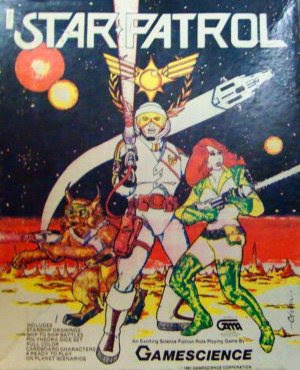
Here's an auction for the 1981 Gamescience box set of Star Patrol, another iteration of Michael Scott Kurtick's Space Patrol system and very similar to Star Trek Adventure Gaming in the Final Frontier, and the predecessor to Terra Games' 1982 Starfleet Voyages.
The listing says "1977", but the game wasn't released until 1981. The box looks to be in very good condition (better than mine!), and it says it's complete. That should mean a bag of Gamescience precision dice, 67 page rulebook with tables and maps, a big foldout deckplan of a Pioneer-class starship, a hexmap, color standup cardboard characters and vehicle counters.
From the auction listing:
Star Patrol is an early D&D-like science fiction role playing game. Character traits are generated with 3D6. Traits are Strength, Dexterity, Constitution, Charisma, Luck and Mentality. The game had other standard D&D features like psionics and savings throws. Instead of fighter, magic user, cleric character classes, Star Patrol has character professions like soldier, engineer, scientist, astronaut, trader, rogue, and spy/diplomat. Characters can be one of 32 alien races. You can also generate your own weird alien race by rolling against random tables, generating a "general type" (mammal, avian, or even a plant or crystalline derivative), a "general shape" (2, 4, 8, or more legs), size, and even your race's home planet's gravity (low, earth-like, or heavy).
Saturday, June 6, 2009
Trek RPG Auction of the Week - 6/2/09


Tuesday, January 20, 2009
Space Patrol (Gamescience, 1977)
 "It is up to the judgement of the Game Master to decide the suitability of a character to a particular scenario. For instance, a Klingon is unlikely to be a member of a Federation landing party." - SPACE PATROL, "Creating Characters", page 2.
As detailed previously, Gamescience's August 1977 release of Space Patrol by Michael Scott Kurtick and Rockland Russo was the granddaddy of Star Trek roleplaying games. Although not officially licensed, it made some tongue-in-cheek use of the terminology and setting of Trek, referencing Kirk, phasers, Klingons, landing parties and so on. At the same time, its ambitions went beyond Trek-with-serial-numbers-filed and also included references to Niven's Kzinti (who themselves had made a guest appearance in the animated Star Trek series), Asimov's Foundation, Heinlein's Starship Troopers, Flash Gordon, Pournelle's Falkenberg's Legion and -- in a last minute addenda -- the new kid on the block, Star Wars.
In other words, Space Patrol was striving to be a definitive adaption of the space opera genre for RPGs. That was pretty ambitious for a 38 page rulebook, especially when you consider that only 14 pages of that are actual rules text (without tables and illustrations), albeit in three columns of 8pt type. Space Patrol wasn't the first or only attempt at that time to create a "sci-fi D&D". 1976 had already seen the releases of TSR's Metamorphosis: Alpha and Flying Buffalo's Starfaring, and Tyr's Space Quest, FGU's Flash Gordon and GDW's definitive science fiction RPG Traveller would follow in 1977, around the same time as Space Patrol itself.
(aside: for a great look back at Classic Traveller, see today's post over at Grognardia)
And, as mentioned in previous posts, Space Patrol would evolve over a number of years as the basis for Heritage's Star Trek: Adventure Gaming in the Final Frontier (1978), Gamescience's Star Patrol (1981), and Terra Games' Starfleet Voyages. I think it's worth re-iterating this upfront because the playability of the game started off rather rocky, but improved to become a more fleshed-out system by the time it was released as Starfleet Voyages.
Despite (and perhaps in part due to) its ambitious intentions, Space Patrol is a prime example of how rules can get in the way of having a good time. In fact, the most fun probably comes from reading the rulebook itself, which is peppered throughout with amusing jabs at the genre that it's supposed to be emulating. Although this -- that it never takes itself too seriously -- is part of its charm, the system itself gets bogged down in unnecessary complexity, rules exceptions, and a necessity to refer too often to poorly implemented tables. The problems with Space Patrol can be summed up as follows: its wargame approach, its presentation and its organization.
First, Space Patrol is very much a miniatures-based and combat-oriented game, and can likely only be played using figures or counters on a grid (not included). The first sections detail character creation by rolling 3D6 to determine the basic attributes: Strength, Dexterity, Luck, Constitution, Charisma and Mentality. The values of these stats generally determine a value or modifier for task resolution. If the attribute is from 9 to 12, there is no modifier. For each point under 9, the player will subtract 1. For each point over 12, the player will add 1. Sometimes the resulting value will require consulting a success probability table, requiring another role on percentile dice. Sometimes it will be compared to an opposed value, such as the defender in combat. Sometimes it will become a factor in further calculations, such as the use of the telekinesis psionic power. The "less than 9, more than 12" system is very consistent, but what happens next is not, depending on the specific task.
Further, Charisma and Mentality really don't figure into the rules much further, and Constitution is almost exclusively a hit point metric. The game presents no economic scheme, no real career, skill or experience systems, and no starship rules at all. As a result, Space Patrol feels like little more than a man-to-man combat system for landing parties than a true roleplaying game.
Second, even for the time, the presentation of the rulebook leaves a lot to be desired. Mediocre artwork unrelated to the text, typos and primitive layout were not at all uncommon in games at the time (I would argue that it can be part of the old school gaming charm). But in this case, the production values and choices really get in the way of simply absorbing the rules. The type is extremely small, the three column layout does not suit the complexity of the text, a great deal of space is wasted (many tables are repeated three times!), and the 25+ tables (so necessary to the game) are at times indecipherable due to use of shorthand. Again this is not uncommon in older games, but more often than not there is enough explanation within the body text to understand the authors' intentions. In the case of Space Patrol there were times when I just had to give up and refer to the 1982 Starfleet Voyages book to decipher some passages.
Third, the rules are very poorly organized. "Creating Characters" is followed by "Creature Creation", "Psionics", "Gravity", "Movement", "Equipment", "Learning" and so on in that order. Important concepts are introduced, described in part, dropped, and picked up later or not at all. The seeds for a really good game are there, but there are few games from the period that could have benefited more from a good editor and (I suspect) the word processing revolution.
One last note, more a curiosity than a criticism. The writing itself is very casual, but I think the authors' antagonistic attitude toward players shows through in a few places. For example:
"We have seen other games with loosely structured formats which, because of local optional rules, became almost unrecognizable from one group to another. We have seen players travelling from one city to another feeling ripped off when trying to play in a new environment until they learn the local options. Thus we ask that you not mess with the rules but rather tell us about your ideas. The rules and corrections that we like will be included in a supplement or sister editions as practical. Thus, hopefully, no one will snivel when playing with new people because of surprise rules."
Which would be fine (well, not really) if the game didn't require house rules to be playable. Then there's this classic from "Creating Characters":
"We recommend that the Mission Master allow only characters personally known to him to be played. This is because we have seen much to offend the honest player in other role-playing games. We have seen other players use characters which some time in the past have been purely fabricated with unusual abilities, or a super character who has been done away with in other 9ames but not left-to-lie in peace. We have also known people who are fond of sitting down and generating some 20 or 30 characters and then throw out all but those who are unusually good. They then claim that all the characters in their stable were in fact, randomly generated."
Sheesh! Seriously, this game would be nearly twice as good if they'd simply used that space to explain "RADIUS or RANGE OF EFFECT/DICE". I'm not sure I've seen so much editorializing in such a small game.
Having said all that, there is good in this game, I feel it. As I mentioned, it really doesn't reach its full potential until Starfleet Voyages, but it does get much better (especially in terms of presentation and organization) as soon as Heritage's Star Trek: Adventure Gaming in the Final Frontier. It still doesn't feel like Star Trek, but I think that very concept was still being defined in the mid-70s. Amongst the real gems in the rulebook for old school science fiction gaming:
Space Patrol is worth tracking down and picking up (at a very reasonable price) if you enjoy odd RPG curios from days-gone-by. But don't expect to be able to play it, and don't expect it to be a good match for a Star Trek game, even of the old school variety. For that, look to the later versions of the game, which I'll be covering in this blog shortly.
Monday, January 12, 2009
Heritage Trek RPG - 2nd Edition Cover
 I meant to include this with yesterday's post. At some point after the initial 1978 release of Star Trek: Adventure Gaming in the Final Frontier, Heritage released a 2nd edition with a revised cover. I've seen it mentioned in a Heritage miniatures collector group, and this image can be found on the Star Trek wiki, Memory Alpha.
I'm don't know what year this was released, but I suspect it was as late as 1981. The January 1982 issue of Different Worlds magazine featured an article entitled "Star Trek: Beyond the Final Frontier" about STAGFF, which would be strange if the game hadn't been re-released fairly recently. I don't have this version myself but if any readers do, or simply know when this version came out, feel free to chime in below!